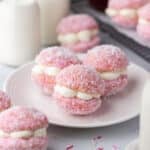
Raspberry Jelly Cakes with Cream
A twist on traditional lamingtons, pink jelly cakes are a classic Aussie treat! Light and airy vanilla cakes are dipped in raspberry jelly, coated in coconut and sandwiched together with a layer of whipped Chantilly cream. They’re bursting with raspberry flavour and are perfect for any occasion.
Servings: 12
Calories: 288kcal
Equipment
- 2 12 x hole dome baking tray or gem trays
Ingredients
- 85 grams raspberry jelly crystals 1 x 85g packet
- 1 cup boiling water 250ml
- ¾ cup cold water 185ml
- 100 grams unsalted butter room temperature
- 115 grams caster sugar ½ cup
- 1 large egg room temperature
- 2 teaspoons vanilla bean paste or extract
- 200 grams self-raising flour
- ½ cup milk 125 ml
- 1 ½ cups desiccated coconut
For the whipped cream
- 300 ml thickened cream
- 2 teaspoons caster sugar
- 1 teaspoon vanilla bean paste or extract
Instructions
Make the jelly
- Place the jelly crystals into a mixing bowl and add 1 cup of boiling water. Use a fork to stir until the jelly crystals have dissolved.
- Add ¾ cup cold water to the jelly and stir.
- Refrigerate the jelly 1-2 hours, until it thickens slightly to a loose, egg white-like consistency. Don't allow it to completely set.
Make the cakes
- While the jelly is chilling, pre-heat the oven to 175°C/347 F fan forced. Coat 2 x 12 hole dome trays or gem trays with a light coating of oil spray.
- Add the room temperature butter and caster sugar to a mixing bowl and use a wooden spoon (or electric beaters on medium-high speed) to beat until light and fluffy.
- Add the vanilla and egg and continue to beat until combined.
- Add half of the self-raising flour and half of the milk and stir until just combined.
- Repeat with the remaining flour and milk and stir until just combined.
- Add heaped tablespoons of the cake batter to the dome trays (24 total).
- Bake for 8-10 minutes, or until the top of the cakes spring back when gently pressed and a toothpick inserted into the middle comes out clean. Be careful not to overbake or they will be dry.
- Place the cakes on a wire rack to cool. Cover them with a tea-towel to prevent them from drying out if the jelly still needs more time.
Assemble
- When the jelly is ready (slightly thickened similar to a loose, egg white-like consistency), place the bowl of jelly onto a clean bench, along with a separate bowl containing the coconut.
- Using a spoon, lower the cakes (one at a time) into the jelly until completely covered.
- Drain the excess jelly and roll the cakes in the coconut until completely covered.
- Place the cakes onto a plate and cover. Refrigerate for 30 minutes to firm up.
For the whipped cream
- Use electric or a handheld mixer to beat the cream, sugar and vanilla together until stiff peaks form.
- Use the cream to sandwich two of the cakes together, making a total of 12 jelly cakes. You can also add a little raspberry jelly (set), raspberry jam or a fresh raspberry to the centre with the cream, if desired. Serve immediately, or cover and refrigerate.
Video
Notes
- Measure the ingredients, for best results. Use a kitchen scale to weigh the dry ingredients in grams. Inaccurate measurements can cause the ratios to be off, resulting in dry cakes, or cakes that don’t rise. If you don’t have scales, fluff the flour with a spoon, spoon it into a measuring cup and level it with a knife.
- Make sure all of the ingredients are at room temperature before mixing, otherwise your batter can split.
- Make the jelly first and place it in the fridge to thicken (but not set!). This will take 1-2 hours, plenty of time to start on the cakes while you wait.
- It is important to get the consistency of the jelly right. If the jelly isn’t set enough, the cakes will soak in too much liquid. This will cause them to become soggy/fall apart. If the jelly sets too much, it won’t soak into the cakes. The jelly should be refrigerated until it partially sets to the thickness of a loose egg white. This will take 1-2 hours, but continually check so it doesn’t set too much!
- I used a silicone dome tray to make the cakes. But you could also use a gem cake pan with small, shallow holes. If you don’t have either, they could be made into regular cupcakes and cut in half to serve (baking times will vary).
- Silicone cake trays make the removal of the cakes much easier. Be sure to use a little oil spray to prevent sticking.
- The cakes should be bite-sized, so don’t overfill the cake tins. One heaped tablespoon is all you need for each cake.
- Cover and refrigerate the cakes for 30 minutes once they have been soaked in the jelly. This allows time for the jelly to absorb into the cakes and to firm up.
- Before filling with cream, the flatter side of the cakes cakes can be trimmed to remove any doming. Keep the nice, rounded side and trim the other side to flatten, if needed.
- Once the centres of the cakes spring back and a toothpick comes out clean, they are ready! They only take around 8-10 minutes, as each cake only has a heaped tablespoon of cake batter. Start to check them around the 8-minute mark and keep an eye on them from there. We want to avoid making the edges dark and overcooked, ensuring the cakes stay light, soft and moist.
- Freezing; I don't recommend freezing assembled jelly cakes, but the plain cakes can be frozen to thaw and soak/assemble later. To freeze the plain vanilla cakes, allow them to cool completely and wrap in a freezer-safe bag or baking paper. Place into an airtight container and freeze for up to 2 months. To decorate, thaw in the fridge overnight and make the jelly 1-2 hours before you are ready to decorate. Follow the rest of the recipe instructions as below.
- Storage; Jelly cakes filled with cream will keep in the fridge and are best eaten within the first 3 days. They can also be made the night before (without the cream added) and kept in an airtight container in the fridge to be filled with whipped cream when you are ready to serve.
- Please note that the nutrition information is based on the mixture being made into 12 cakes (2 cakes sandwiched together with cream), with one cake being one serve. The nutritional information is an estimate only and does not take into account any additional toppings or sides served with the cakes.
- This recipe is made using Australian cups and spoon measurements. Any reference to cups or spoons in this recipe is in Australian metric. Due to cup sizes varying from country to country, I advise adjusting if necessary.
Nutrition
Calories: 288kcal | Carbohydrates: 28g | Protein: 4g | Fat: 18g | Saturated Fat: 13g | Polyunsaturated Fat: 1g | Monounsaturated Fat: 3g | Trans Fat: 0.3g | Cholesterol: 48mg | Sodium: 30mg | Potassium: 112mg | Fiber: 2g | Sugar: 14g | Vitamin A: 380IU | Vitamin C: 0.2mg | Calcium: 33mg | Iron: 1mg